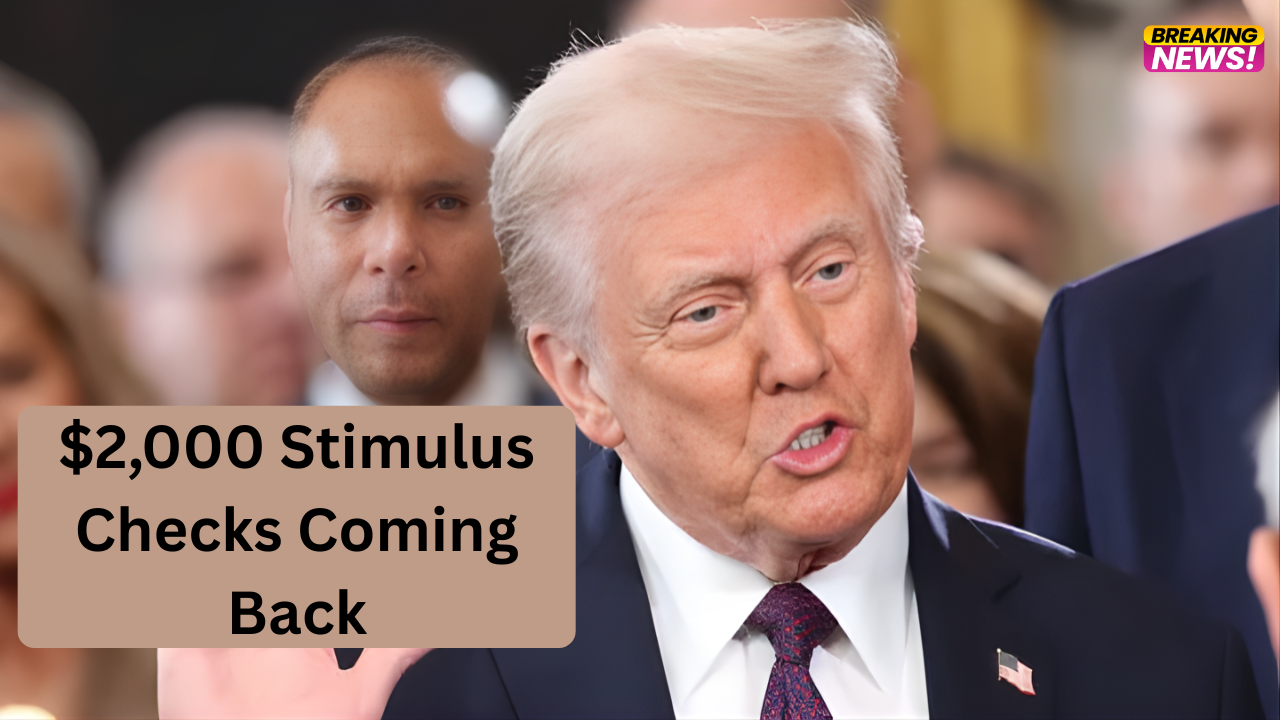
$2,000 stimulus checks are back in the headlines, but as of late 2025 they are still a political promise, not an approved payment. President Donald Trump is pushing a plan to send “tariff dividend” checks of about $2,000 to many Americans, yet Congress has not passed any law to make those payments real, and key lawmakers in both parties remain skeptical.
What the new $2,000 idea actually is
The current talk about $2,000 checks centers on Trump’s proposal to use revenue from his tariffs on imported goods to fund one-time “tariff rebate” or “tariff dividend” payments. In interviews and social posts, he has floated checks of around $2,000 for low‑ and middle‑income households, while excluding higher‑income Americans.
White House officials have confirmed that this concept is actively being explored and say Trump “is eager” to deliver the payments, but they also admit that new legislation is required. Treasury Secretary Scott Bessent and other aides have said publicly that Congress controls the federal purse and that the administration cannot simply send out checks without a bill.
Where the proposal stands in Washington right now
Despite viral rumors and video thumbnails promising “approved $2,000 checks,” there is still no federal law authorizing a new nationwide stimulus payment. Fact‑checking outlets, tax professionals, and even IRS‑focused articles all stress that no 2025 federal stimulus package exists and that any future payments would need congressional approval and an official IRS announcement.
Inside Washington, Trump’s tariff‑funded idea faces serious hurdles. Analysts estimate that sending $2,000 checks to most adults would cost in the hundreds of billions of dollars, likely more than total new tariff revenue, raising concerns about deficits and inflation. Several Republican lawmakers and budget hawks argue that tariff income should go toward reducing the national debt instead of new spending, while many Democrats have been cautious or silent so far.
Who might qualify if Congress ever says yes
Because there is no actual law yet, eligibility details are still fuzzy, but officials and reports give a rough sketch of what Trump’s team has in mind. Treasury and White House sources have suggested limiting checks to households earning under about $100,000 a year, which would cover roughly 60 percent of U.S. households and exclude the highest‑income group.
Trump has repeatedly described the target group as “working families” and “middle‑ and lower‑income” Americans, echoing the income‑based phase‑outs used in earlier COVID‑era stimulus rounds. Commentators expect that, if a bill is written, it would likely mirror those earlier designs: full checks below a certain income, partial checks in a phase‑out range, and no checks above a higher threshold, but nothing is final until Congress drafts and passes legislation.
When could $2,000 checks actually arrive?
On timing, Trump has tried to set expectations: he has said the checks will not arrive by Christmas 2025 and has suggested “next year sometime,” with some comments pointing to mid‑2026 as a possible window if all goes well. One widely cited report notes that he promised “$2,000 tariff dividend checks” starting around the middle of 2026, tying the idea to political milestones like the midterm elections.
However, every major analysis emphasizes that these dates are aspirational. To become real, the plan would have to be written into a bill, pass both chambers of Congress—likely using a tight reconciliation vote—and then be implemented by the IRS, which takes additional time. Given the opposition and complex budget math, many economists and journalists warn that there is a significant chance the proposal is watered down, delayed, or never enacted.
Key political and economic arguments around the checks
The debate over reviving $2,000 checks blends politics, economics, and public frustration over living costs. Supporters say rebate payments would share tariff revenue with the people who ultimately pay higher prices, offering visible relief to families squeezed by housing, food, and medical bills. Politically, direct checks are popular and easy to understand, which is why they keep returning in campaign promises.
Critics counter that tariffs themselves act like a tax on consumers and businesses, so paying people with tariff revenue is like giving back money that was already taken from them—often with extra administrative cost. Budget watchdogs also note that rough cost estimates for $2,000 checks exceed the tariff dollars collected, implying that the government would still need to borrow or cut elsewhere to make the math work.
What all this means for your wallet right now
For individuals, the most important fact is that no new federal $2,000 stimulus checks are currently approved for 2025, and there are no official IRS payment dates or application portals. If you see posts claiming that checks are “guaranteed,” “already approved,” or available via a special link, you are almost certainly looking at misinformation or a scam.
Financial planners and consumer advocates recommend treating any future federal stimulus as a pleasant surprise, not part of your core budget. Instead of counting on a check that might never come, focus on programs that do exist today—such as tax credits, state‑level rebates, and Social Security or SNAP benefits—and track credible news sources for genuine legislative developments in Washington.
How to protect yourself from $2,000 check scams
Scammers are already exploiting the buzz around possible $2,000 payments, sending texts, emails, and social media messages that promise faster checks in exchange for personal information or “processing” fees. The IRS and other agencies repeatedly stress that you do not need to sign up by text or social media for federal payments and that they never ask for bank logins, gift cards, or up‑front payments to release money.
If you want to track real developments, stick to official government websites (IRS.gov, Treasury.gov, WhiteHouse.gov) or long‑established news outlets, and be skeptical of videos or posts that rely on sensational thumbnails and vague promises. Until Congress passes an actual bill and the government publishes clear guidance, the safest assumption is that $2,000 federal stimulus checks are still just a proposal, not money you can bank on.
FAQs
Q1 Have $2,000 federal stimulus checks been approved again?
No, there is currently no law authorizing new $2,000 federal stimulus checks, and the IRS says no 2025 stimulus package has been enacted.
Q2 What exactly has President Trump proposed?
He has proposed “tariff dividend” checks of about $2,000, funded by revenue from import tariffs and targeted mainly at low‑ and middle‑income households, but the plan needs congressional approval.
Q3 How can I know if new checks become real?
Watch for an actual bill passed by Congress, signed by the president, and followed by official announcements from the IRS or Treasury; ignore unsolicited messages or links that claim you can “apply” for checks now.
