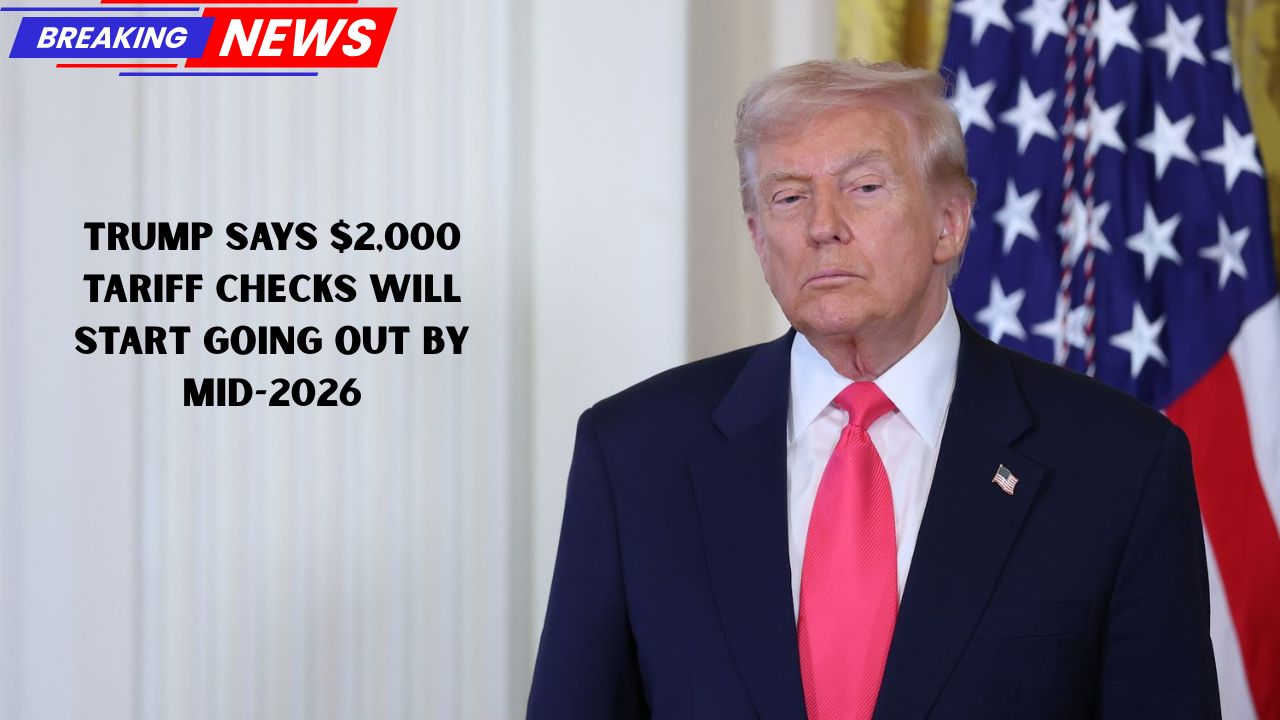
President Donald Trump says Americans will start receiving $2,000 “tariff checks” around the middle of 2026, but the plan is still only a proposal and faces significant political, legal, and budget hurdles. These payments would not go out automatically unless Congress approves new legislation and tariff revenues prove large enough to cover the cost.
What Trump Is Promising
Trump has revived his idea of a “tariff dividend,” a one-time payment of at least $2,000 per person for low- and middle-income Americans, funded from the money the federal government collects on imported goods. In a recent Oval Office appearance, he said the government would “likely” begin sending these checks “around the middle of next year, maybe a bit later,” framing the payout as a way to let ordinary citizens share in the gains from his aggressive trade policy. White House press secretary Karoline Leavitt has confirmed the administration is “committed” to the concept and exploring legal paths to make it happen.
How the Tariff Checks Would Supposedly Work
Under the current outline, the payments would resemble past stimulus checks but would be justified as a rebate of tariff revenue rather than deficit-financed aid. Treasury officials and outside analysts expect the program to be run through the IRS, using recent tax returns to determine income and eligibility and sending money via direct deposit or paper checks to qualifying households. Administration officials have floated an income cap near or below 100,000 dollars for single filers, with higher thresholds for married couples, so that only low- and middle-income families receive the full 2,000 dollars.
Who Might Be Eligible
While final rules do not yet exist, the policy conversations suggest three broad criteria for eligibility.
Income: Limited to low- and middle-income taxpayers, with a possible phase-out above roughly $75,000–$100,000 for individuals and around double that for couples.
Filing status: Likely based on filed 2025 tax returns; non-filers might need a simple claim form, as in earlier stimulus rounds.
Residency and ID: U.S. citizens and possibly some resident taxpayers with valid Social Security numbers would qualify; non-resident aliens and those claimed only on ITINs might be excluded.
Until a bill is written, these criteria are only educated guesses based on prior stimulus programs and comments from officials and policy analysts.
The Math Problem: Can Tariffs Fund It?
Budget experts question whether tariff income can realistically pay for checks of this size.
Item
Rough Estimate (Annual or One-Time)
Expected tariff revenue, 2025–2026
200–300 billion dollars per year
Cost of 2,000 dollars per adult only
Around 300–350 billion dollars
Cost if most citizens get 2,000
Up to 600 billion dollars
Gap between revenue and full payout
100–300 billion dollars or more
Independent research groups and academic budget labs argue that even under optimistic assumptions, current and projected tariffs are not enough to fund a universal 2,000 dollar dividend in one year without heavy borrowing or cuts elsewhere in the budget. That shortfall is a key reason many economists call the promise fiscally risky.
Legal and Political Roadblocks
Despite Trump’s timeline, he cannot send the checks unilaterally. Congress holds the constitutional power over spending and must approve any new refundable credit or direct payment. Lawmakers from both parties have raised concerns about cost, inflation risks, and fairness, especially because tariffs tend to raise consumer prices while any dividend would arrive only once. At the same time, the Supreme Court is reviewing the legality of some of Trump’s broad tariff actions; if the Court narrows or overturns them, the government could owe refunds to importers, sharply reducing or even wiping out the revenue that would finance a dividend.
Market Odds and Expert Skepticism
Prediction markets and financial analysts currently see the plan as a long shot. Trading on platforms that track political and economic events suggests only a single-digit percentage chance that a tariff-dividend law will be enacted within the near term, and even lower odds that full 2,000 dollar checks will reach most Americans on Trump’s mid-2026 schedule. Commentators note that a similar rebate idea stalled in Congress earlier in 2025, and there is still no detailed legislative text, cost estimate from the Congressional Budget Office, or bipartisan support.
For now, Trump’s mid-2026 date is a political pledge, not an official payment schedule. There is no application form, no automatic enrollment, and no guarantee that any checks will be issued. If Congress eventually approves a package, the IRS would likely publicize eligibility rules, timelines, and scam warnings, much as it did with prior stimulus rounds. Until that happens, households should treat the 2,000 dollar tariff checks as a possibility—one that depends on legislation, court rulings, and the health of tariff revenues—rather than something to build a 2026 budget around.