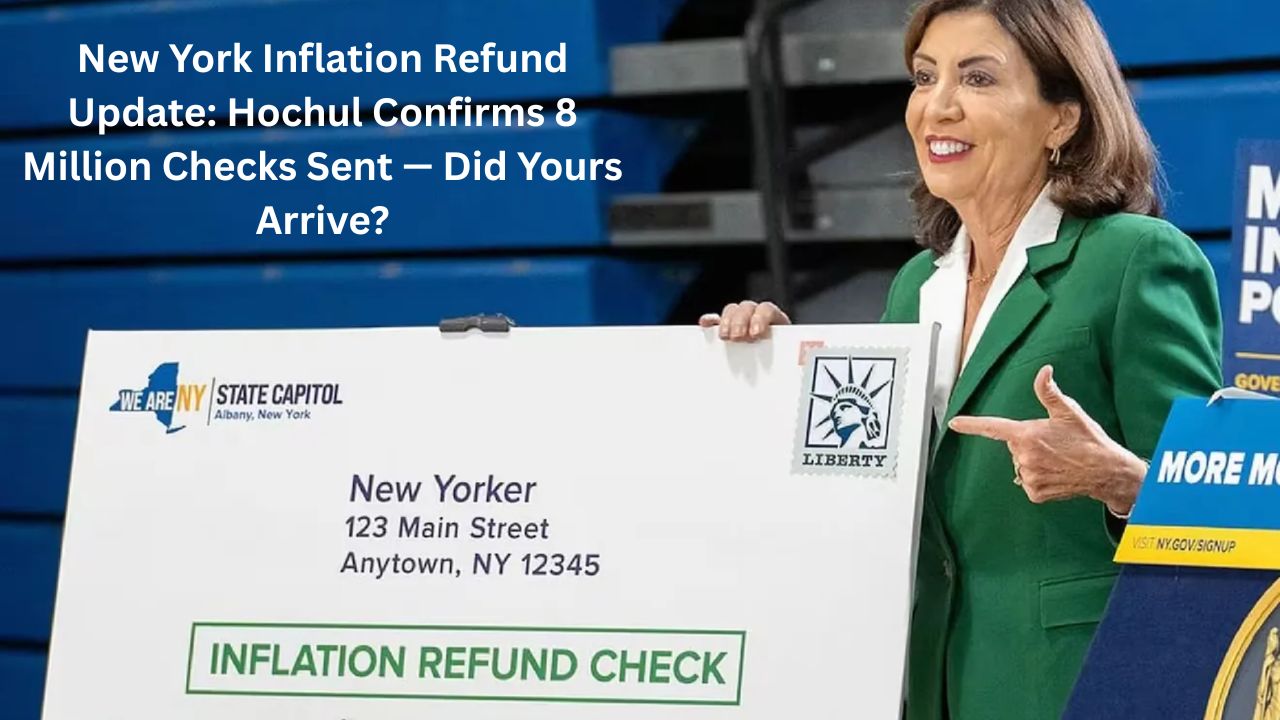
New York’s first-ever Inflation Refund Check program has reached a major milestone, with Governor Kathy Hochul confirming that more than 8.2 million checks have now been sent to eligible residents across the state. The initiative, worth about $2.2 billion in direct relief, is designed to return part of the state’s higher inflation-driven sales tax revenue back to taxpayers in the form of one-time payments of up to $400 per household. If you are wondering whether your check should have arrived, understanding the eligibility rules, payment amounts and regional distribution is the best place to start.
What Is the Inflation Refund Check Program?
The Inflation Refund Check program was created in the FY 2026 New York State Budget as a one-time affordability measure to help residents cope with higher prices for rent, food, utilities and other essentials. The refunds are not a recurring benefit but a single direct payment per eligible tax-filing household, administered by the New York State Department of Taxation and Finance. Payments began going out in late September and continued through October and November, with the main mailing phase now completed and smaller batches still being processed.
Who Is Eligible — And How Much Could You Receive?
Eligibility is based entirely on your 2023 New York State personal income tax return (Form IT-201). To qualify, you must:
- Be a New York resident who filed a 2023 state return.
- Not be claimed as a dependent on someone else’s return.
- Fall within set adjusted gross income (AGI) limits for your filing status.
Benefit amounts depend on income and filing status, with higher checks aimed at low- and middle-income households:
Single or married filing separately:
- AGI up to 75,000: typically about $200.
- AGI 75,001–150,000: about $150.
Married filing jointly or qualifying surviving spouse:
- AGI up to 150,000: up to $400.
- AGI 150,001–300,000: about $300.
Heads of household and some surviving spouses follow similar brackets, with maximums around $200–$300 depending on income.
Where the Money Went: Regional Breakdown
| Region |
Checks Sent (approx.) |
Total Amount (USD, millions) |
| New York City |
3,536,000 |
828.8 |
| Long Island |
1,251,000 |
316.4 |
| Capital Region |
475,000 |
122.8 |
| Western New York |
585,000 |
152.7 |
| Central New York |
321,000 |
83.8 |
| Hudson Valley & Mid-Hudson |
~1,000,000+ |
~230+ |
| Southern Tier & North Country (combined) |
~400,000+ |
~120+ |
| Statewide Total |
8,210,000 |
~2,035 |
Did Your Check Arrive Yet?
According to the Governor’s office, the “bulk” of checks have already been mailed, meaning most eligible households should have seen their payment by late November. Checks are being issued either as paper checks sent to the mailing address on your 2023 tax return or as direct deposits in some cases where banking information is on file. Smaller follow-up batches will continue to go out as the Tax Department finishes processing late or amended returns and identifies additional eligible filers.
If your neighbors have received their checks but you have not, possible reasons include a late-filed 2023 return, an address change not yet updated with the Tax Department, or income or dependent status that puts you outside the eligibility rules.
How to Check Your Status or Fix Problems
- Review your 2023 NY tax return to confirm your filing status, AGI and address.
- Log into your New York State Online Services tax account to see notices or updates related to the program.
- Contact the Department of Taxation and Finance directly if you believe you meet the criteria but have not received a check after a reasonable mailing window.
Officials emphasize that you should be cautious of scams: no state agency will call, text or email asking you to pay a fee or provide bank details to “release” your refund.
Are These Checks Taxable?
At the state level, the refunds are treated as non-taxable and will not be added back into your New York income when you file your next state return. Federally, however, many such special state payments are considered taxable income, and the IRS may require you to report the amount on your federal return, potentially via Form 1099-G. Taxpayers who are unsure how the refund interacts with their federal return, or with benefits like SNAP or housing assistance, should consult a tax professional or trusted advisor.
What This Means for New Yorkers Going Forward
The Inflation Refund Check program is one pillar of a wider “Affordability Agenda” that also includes middle-class income tax cuts, an expanded state Child Tax Credit worth up to $1,000 per child, and universal free school meals aimed at saving families around $1,600 per student each year. While a one-time payment of $150–$400 will not erase the effects of prolonged inflation, it offers short-term breathing room for millions of households and signals that Albany is willing to use surplus revenue for direct relief.
For now, if you filed a 2023 New York return, fall within the income thresholds, and are not a dependent, the odds are high that your inflation refund is either already in your mailbox or on its way. Keeping your address and tax records current will ensure you are on the list for any future relief efforts built on the same model.