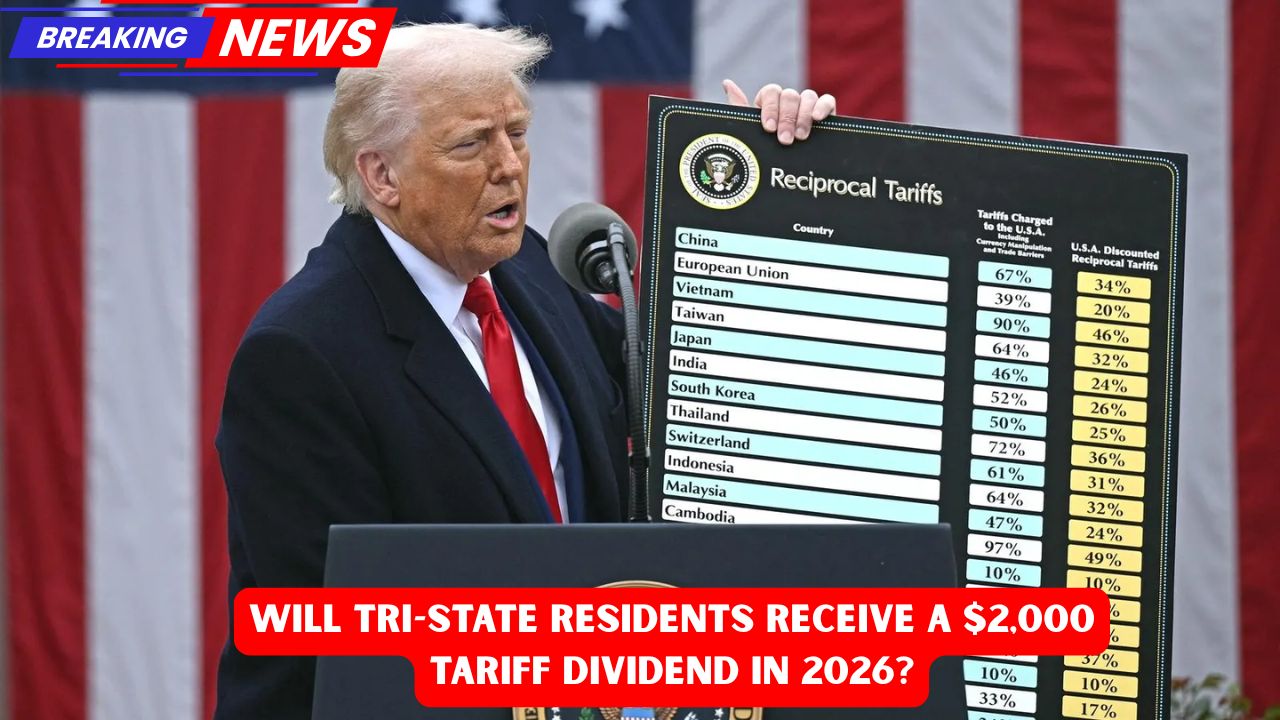
Tri-State residents are not guaranteed to receive a $2,000 “tariff dividend” in 2026 at this point. The payment is a political proposal from President Donald Trump, not an approved program, and it would require new legislation and enough tariff revenue before any checks could actually go out.
What the $2,000 Tariff Dividend Is
President Trump has proposed sending a one-time $2,000 payment to most Americans, funded by money collected from new and higher tariffs on imported goods. The idea is framed as treating citizens like “shareholders” in the economy, with tariff revenue returned to the public instead of staying entirely in the federal budget. The White House has described this as a “tariff dividend,” separate from traditional stimulus checks funded by borrowing.
Who Might Qualify If It Happens
So far, the administration has only sketched out broad eligibility. Trump has said that “high-income people” would be excluded, with the focus on low- and middle-income Americans. Analysts often assume the income cutoff could fall somewhere around $75,000–$100,000 for individuals and about double that for couples, similar to past stimulus checks, but no final thresholds or rules exist yet. That means Tri-State residents in places like Maryland, Pennsylvania, and West Virginia would be treated like other Americans—anyone under the eventual income cap could qualify, but nothing is locked in.
What Has Actually Been Promised
In mid-November 2025, Trump publicly said he expects $2,000 tariff dividend checks to start going out “around the middle of next year, maybe a bit later,” referring to 2026. The White House has repeated that he is “committed” to the idea, but top economic officials acknowledge that Congress must authorize a new program before the Treasury can legally send these payments. Without a bill setting eligibility, amounts, and funding rules, the promise is only a proposal and a political goal, not a scheduled payment.
Key Facts About the Proposal
Question
Current Status (late 2025)
Is there a $2,000 law on the books?
No. It is a White House proposal, not enacted legislation.
Who would administer the payments?
Likely the IRS/Treasury, similar to prior stimulus checks.
Target income group
Low- and middle-income; exact cutoff not defined.
Claimed start timing
Around mid-2026, “maybe later,” if Congress approves.
Funding source
Federal tariff revenue on imports.
These details come from White House briefings, media interviews with Treasury officials, and independent budget analyses reviewing the numbers behind the plan.
Can Tariffs Really Pay for $2,000 Per Person?
Budget experts are skeptical that tariffs alone can fund a nationwide $2,000 payment. As of late 2025, tariff revenues were under $200 billion for the year, while a single $2,000 check for roughly 150–170 million eligible Americans could cost $300–450 billion, depending on the income cutoff. Some studies estimate that, on a revenue-neutral basis, current tariffs might only sustain a $2,000 dividend every other year, and possibly not as soon as 2026. That financial mismatch is one reason analysts say the plan faces serious “math problems” even before politics enter the picture.
Political and Legal Obstacles
Even if tariff revenue were sufficient, Tri-State residents will not see a check unless Congress passes a new law creating the program. Lawmakers in both parties have raised concerns about cost, inflation risks, and fairness, especially because tariffs tend to raise consumer prices while any dividend would arrive only once. There is also legal uncertainty over some of Trump’s tariffs themselves: ongoing court cases and a possible Supreme Court ruling could reduce or overturn key duties, shrinking the money available for any dividend program.
For residents of Maryland, Pennsylvania, West Virginia, and neighboring Tri-State areas, there is currently no official signup process, application form, or guaranteed date for a $2,000 tariff dividend in 2026. If Congress approves a plan, eligibility rules would likely mirror previous stimulus programs, based on income and tax filing status, and payments would probably be distributed automatically through IRS records. Until a specific bill is passed and signed, however, the tariff dividend is best understood as a proposed benefit rather than an assured $2,000 check.